
Reflections on “SHOUT IN THE DARK: A Guide to Hope & Good Grief” by Deborah Slater Dance Theater
When I entered the theater, the performance had already begun. I was instantly enveloped in a swirling projection of lush green landscapes that licked all four walls. I found myself swept into the strange illusion that the room was expanding.
Onstage, three performers moved with great deliberation. As I took a seat, one performer tapped another on the shoulder, and then ducked and moved away like a bird. A fourth dancer joined, and a few minutes later, a fifth. The movements were relatively minimal and pedestrian, but the performers moved with a kind of modern dance formality—clean lines and crisp pathways—and a level of exquisite attention. They seemed to really see each other. And then to respond.
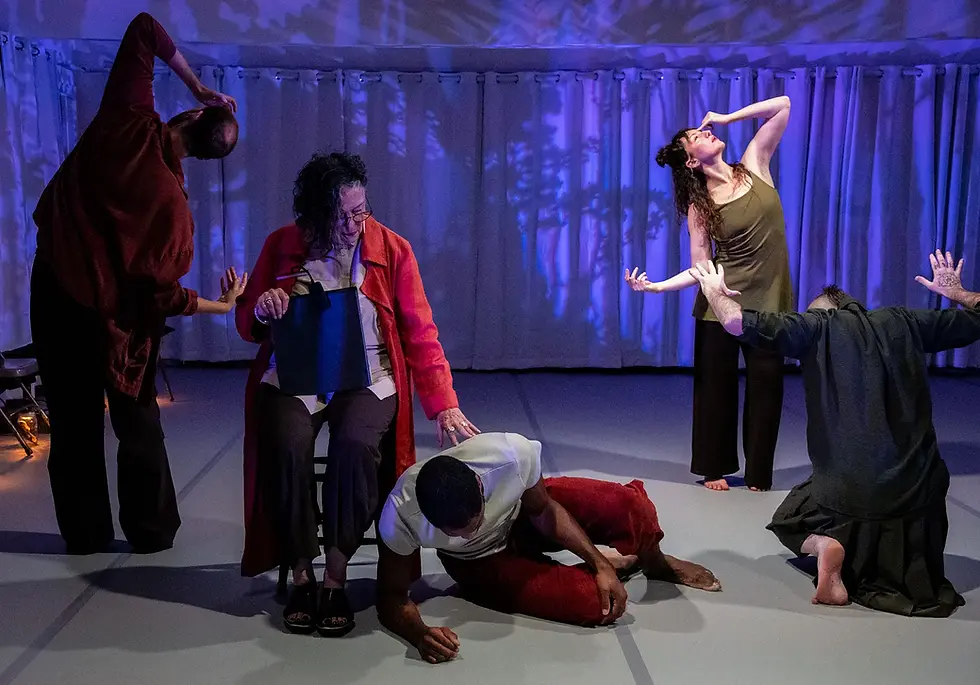
The lights dimmed and director Deborah Slater walked onstage, a black binder held to her chest. She welcomed us and shared about the origins and inspiration for the piece—questions around isolation and connection in the wake of covid, and hope and grief. While she spoke, the dancers continued to move silently around her. I wasn’t sure what to make of the dynamic that this staging decision created.
In some ways, it created a kind of permeability to the dance that felt pleasing to me. It exposed the process, almost like stripping away plaster and sheetrock to expose the structural elements of a building. Slater talked about how the embodied research of hope had led to phrase material that we would see shortly. Even before we saw the phrase, I found myself viewing the movement in front of me with new eyes. The precise and tender movements from the prologue no longer washed over me in a poetic gestalt. Instead, I saw it as the result of a meaningful collective process by the people on stage. It became somehow more quotidian and more heartfelt at the same time.
On the other hand, it created a power dynamic that felt distracting to me. As a visual, having Slater describing the process on stage while the dancers continued to move around her, evoked tropes around voiceless or objectified dancers and “boss” directors. I wondered why Slater had chosen to have the dancers continue moving while she spoke. I also wondered why she had chosen to tell us so much about the piece at the beginning. With so much information, I lost some of the wide-eyed receptivity I had felt in the prologue, and instead sunk into feeling as if I had just been told what I would see. Now I would measure everything I saw, to a certain degree, against what I expected the piece to be “about.”
Slater took a seat on a stool center stage, and laid her binder on her lap. The dancers lined up beside her and began a gesture phrase that she had described as originating from “where hope lives in the body.” The movement was beautiful and precise, and I enjoyed seeing it multiple times. Each of the dancers embodied the movement distinctly and heartfully. I was taken out of the rawness of the moment however, by “knowing” so much about it. I felt like I was dissecting it into its parts, quantifying how it had been constructed and measuring the compositional elements that made it up. I wondered what I would have seen if I hadn’t been told anything about it. A part of me wished I’d had the opportunity to experience it without these preconceived notions.
One by one, the dancers collapsed (what I read to be expressions of loneliness, overwhelm, and isolation—again, I wondered what I might have seen if I hadn’t been told so much in words). A few times a dancer laid their head on Slater’s lap or shoulder to be comforted by her. I wondered about this staging choice as well. In my eye, it cast her as a kind of “protagonist” of the work because she was the only one who had spoken, and she was the only one sitting while the others moved around her. If that was the intention, I wanted to know why. If it wasn’t, I wondered why she had chosen to stay so “center stage” while the dancing took place without joining in. I assumed the intention was related to her interest in connection that she had described at the beginning, but the resulting image took me out of the performance.
Overall, I found the dancing in this work to be stunning. Each of the performers moved fully and expressively. They each had flavors all their own, and infused the work with personality and intention. Their moments of connection were sensual, tender, and powerful. One solo by Nol Simonse in particular stuck with me as he capered around the stage with the goofiest smile on his face. There was a playfulness to his presence that felt contagious.
I also appreciated the smooth flow of the piece, from solos to duets, to ensemble moments and back again. The seams that held it together melted under the skillful performance of the ensemble, and I appreciated the pace at which it unfolded—never rushing, but always offering some new tender or beautiful or heartfelt development. After the opening, Slater moved upstage and was in a less central position. I found that her presence softened into a “witness” role as opposed to “protagonist” or “narrator,” and my attention was no longer split.
In the end, I walked away feeling struck by the full-hearted commitment that each of the performers brought to their movement, as well as the love poured into the process by all the artists. I am also struck by the question of how spoken language and physical movement might interact to invite an audience into a work. When and how can words offer inroads to engagement? And when might they distract from or dilute the potency of nonverbal communication? Overall, I was grateful for the generosity of all the artists, and the opportunity to witness the work.


Comments